What the Robotics Beginner Build includes
The Robotics Beginner Build is a starter package for anyone who wants a hands-on first project without needing a full workshop. It is designed around a simple wheeled robot that can move forward, turn and respond to basic control inputs, so learners get a clear introduction to motion, wiring and troubleshooting. The kit is practical for makerspaces in Braamfontein, school labs in Pretoria East, or after-school rooms in Soweto where shared equipment needs to be easy to use and easy to store.
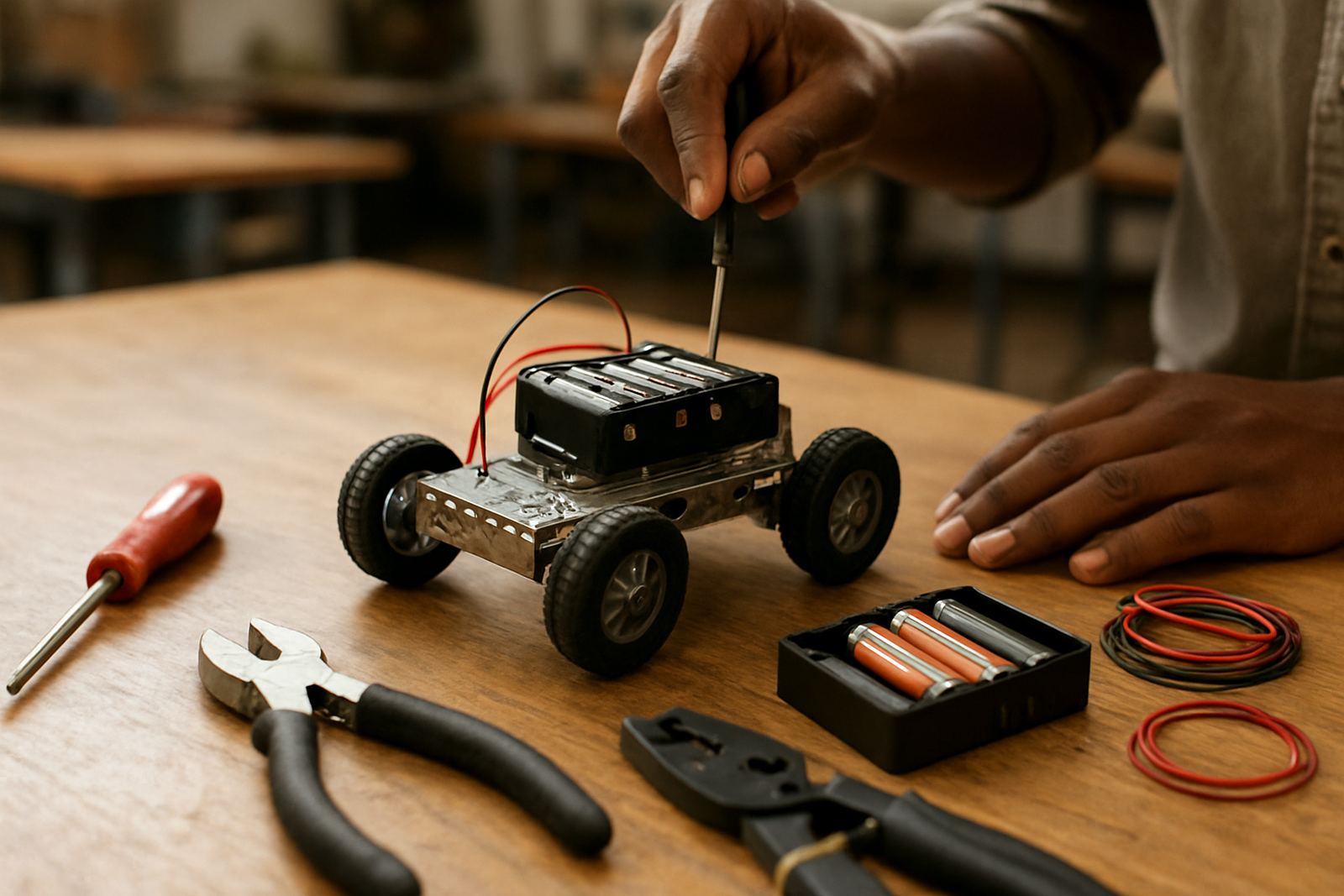
Each build focuses on the parts that matter most for a first robotics project: a motor base, wheel set, control board, battery housing, wiring and fixings. The aim is to keep the learning direct, while still giving enough scope for a group to understand how the system works from start to finish.
- Drive base with two wheel motors
- Control board for simple input and logic
- Battery holder and basic wiring set
- Chassis parts, fixings and mounting hardware
- Starter guide for assembly and testing
Sizes and options for different group settings
This product is available in small, medium and group formats so it can suit one learner, a classroom or a public makerspace intake. The smallest option works well for a single participant or a parent and child session. The mid-size option suits a table of four to six learners. The group option is better for training venues where a facilitator wants several robots on the go at once, with spare parts on hand for quick replacement.
If you are setting up in a shared space, we can also align the kit with your storage and member onboarding needs. In a busy venue, smaller component packs help reduce mix-ups and keep the build moving. For schools and partner makerspaces, labelling and colour coding can be added as part of your starter kit plan.
- Single build pack for one learner
- Table pack for 4 to 6 learners
- Group pack for workshops and training days
- Component sorting trays available on request
Where this robot kit suits best
The Robotics Beginner Build is well suited to maker training, STEM clubs, school labs, holiday programmes and startup space kits where first-time users need a controlled, low-risk introduction. It also works well for outreach events and event maker stations, where visitors want to complete a build in one session and take home a working result. In coastal areas like Durban or Gqeberha, it helps to keep components dry and stored in sealed tubs because humidity can affect contacts and fasteners over time.
For Johannesburg venues, especially shared workshop spaces, the kit is compact enough for a clean bench layout and simple enough to explain in a short induction. It is a good fit where load-shedding is part of planning, because the build itself does not need mains power once the battery is charged.
- Makerspaces and shared workshops
- School labs and technical clubs
- Holiday programmes and youth events
- Facilitator-led beginner training sessions
Power needs, setup and installation notes
The kit is powered by low-voltage battery supply and does not require a gas connection. Setup is straightforward, with the robot built on a flat work surface using hand tools and basic supervision. A small test area of about 2 metres by 2 metres is enough for the first movement checks, though a larger clear space is better for proper turn tests and obstacle runs.
For venues with load-shedding, it is best to charge any rechargeable batteries ahead of the session and keep a spare set available. If your venue uses shared charging points, plan for one charging station per 6 to 8 kits so groups do not wait around. No fixed installation is needed, but we do recommend a labelled storage tub, a dry shelf and a simple sign-out process for batteries and tools.
- Low-voltage battery powered
- No gas or water supply needed
- Flat table or bench for assembly
- 2 m x 2 m minimum test space
Care, servicing and parts to keep on hand
Regular care is simple and should be built into your workshop routine. Check wheel alignment, battery contacts and loose fasteners after each session. Dust and small offcuts can build up around moving parts, so a quick brush-down and a wipe with a dry cloth is usually enough. If the robot is being used in a school or shared venue, a monthly maintenance check is a good habit, especially where many learners handle the same kit.
We also recommend keeping a small consumables box with spare screws, cable ties, insulating tape and a few replacement connectors. Motors and switch parts should be checked for wear before each new intake, because beginners can apply more pressure than expected while building. A quick record sheet helps facilitators spot repeated faults and sort out parts before they slow down the next group.
- Monthly inspection for shared spaces
- Keep spare fixings and connectors nearby
- Store in a dry box away from direct sun
- Remove batteries during long storage periods
What to check before placing an order
Before ordering, check the number of learners, the age group, the available bench space and whether the session will run in one day or over a few visits. It helps to know whether you need extra facilitator support, school lab refresh assistance or a full startup space kit with storage solutions and safety signage setup. For teams in Braamfontein, Sandton or Midrand, we can match the kit count to your room size and your member onboarding flow.
You should also confirm whether your venue needs pre-sorted parts, printed labels or a maker audit before the first workshop. If your group includes younger learners, ask for a simplified parts set and a clearer step-by-step build order. It is easier to plan properly upfront than to stop mid-session because a connector, screw size or battery type does not match the room set-up.
- Learner count and session length
- Table space and storage available
- Battery type and charging plan
- Need for facilitator support or signage
- Any special parts sorting or labelling
Key facts
| Product type | Beginner robotics starter build kit |
|---|---|
| Main build | Simple wheeled robot with motor drive |
| Power | Low-voltage battery powered |
| Recommended space | 2 m x 2 m minimum test area |
| Best for | Schools, makerspaces, youth programmes and training sessions |
| Support | Assembly guidance, facilitator support and spare parts planning |