The brief from a busy George workshop
The client was a community workshop in George serving hobbyists, school groups and small teams working on wood, light metal and repair projects. Their shared tools were being moved by hand from one corner of the room to another, which caused clutter, missing items and a lot of wasted setup time before each session.
The brief was simple enough to say, but not simple to solve: create mobile trolleys that could carry mixed tools, stay stable on a slightly uneven workshop floor, and make it easy for volunteers to see what was inside at a glance. They also wanted storage that would work for a mixed crowd, from experienced makers to first-time users who need things labelled clearly.
The space had limited wall room, narrow walkways and regular load-shedding, so the solution had to be practical without relying on anything fussy. Coastal humidity from the Garden Route also meant materials and fixings needed to cope with damp air and regular cleaning.
Constraints that shaped the trolley design
We worked around three main limits. First, the workshop could not spare much floor area, so every trolley had to fit through standard doorways and turn easily in tight aisles. Second, the team needed a layout that would support quick clearing at the end of a session, because the room doubles up for training and community events. Third, the client wanted something that could be repaired locally if a wheel, handle or divider failed later on.
- Clear aisle width allowance: 900 mm minimum
- Overall trolley width: 700 mm for easy movement through doors
- Locking castors: 4 per trolley for stability
- Height: 1 150 mm working height for easy access
- Load capacity target: 120 kg per trolley
We also had to think about safety. Open tools can shift during movement, so every shelf and compartment needed a retaining edge or closed front. For a shared room, that matters. It reduces drop risk, keeps sharp items in one place and makes it easier for a facilitator to do a quick end-of-day check.
What we supplied and set up
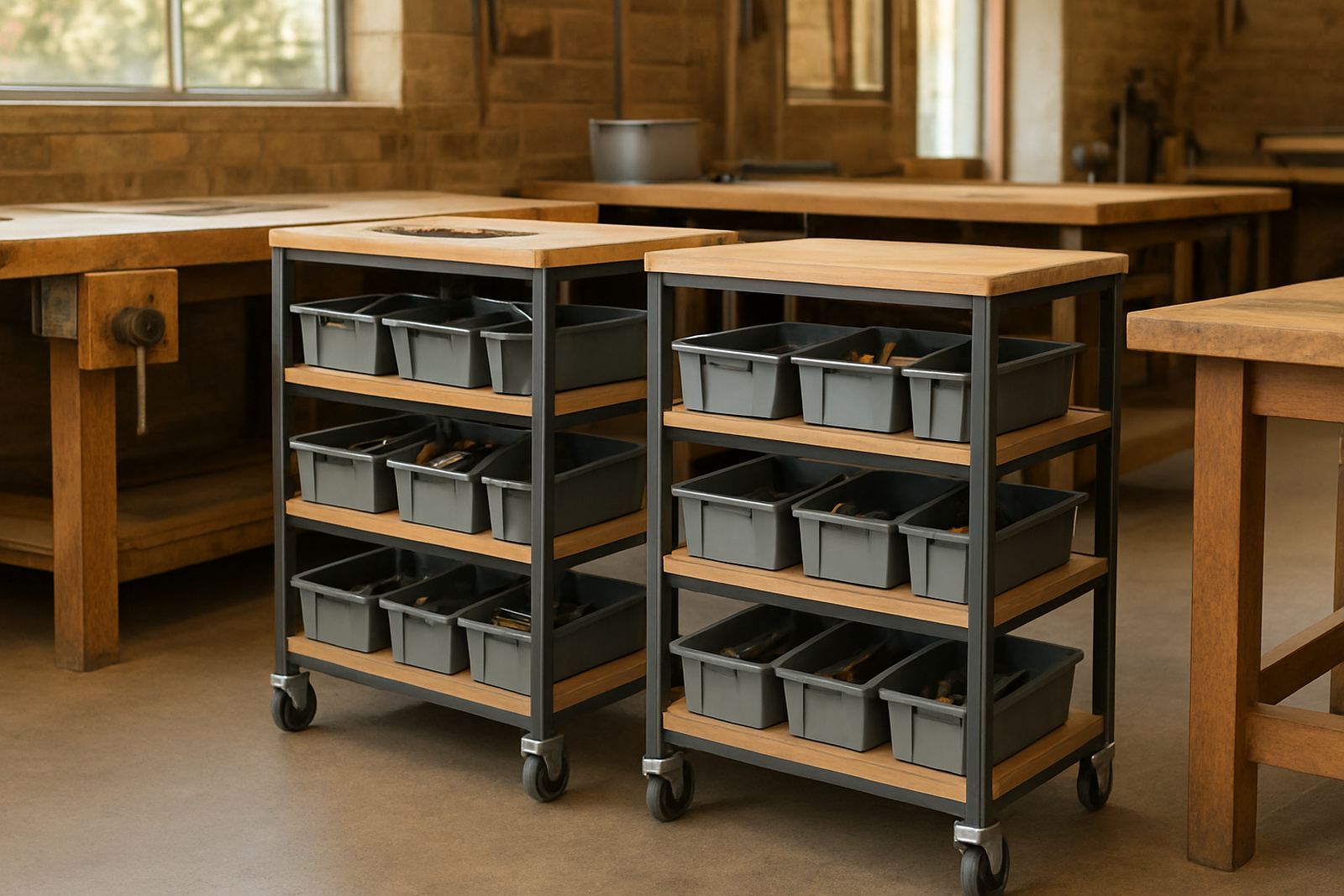
We provided a set of mobile maker trolleys arranged by task rather than by random storage. One trolley was set up for hand tools, another for measuring and marking gear, and a third for consumables and small parts. This made it easier for the team to pull out only what they needed for a class or repair session.
The key features were chosen for daily use in a community setting:
- Powder-coated steel frames for long service life
- Locking swivel castors for movement and parking
- Perforated side panels for quick visual checks
- Removable trays and divider bins for small parts
- Label strips on every shelf and bin face
- Rubber edge trims where hands and cables pass often
We also helped organise the trolley contents, grouping items by task and frequency of use. Fast-moving items stayed at mid height, heavier items went lower, and lighter consumables were placed near the top. That sounds basic, but in a shared workshop it saves time every day and cuts down on bending, searching and double-handling.
Timeline and delivery in three working weeks
The project ran over three weeks from planning to handover. In week one we completed the site review, checked access routes and measured the storage area. In week two we finalised the trolley layout, storage mix and labelling plan. In week three we delivered, positioned and tested the units with the workshop team.
During handover we walked the staff through trolley use, parking points and the end-of-session reset routine. We also discussed what should stay on the trolley and what should be stored elsewhere, because overloading a mobile unit is a common mistake in busy spaces. The goal was to keep the system light enough to move by one person, but strong enough for group use.
There was one practical adjustment on site: a narrow passage near the entrance needed a tighter turning method than first expected, so we rechecked wheel position and parking habits before signing off. That small change made a big difference to daily handling.
Results after the first rotation of classes
Once the trolleys were in use, the workshop saw quicker changeovers between sessions and far less clutter around the main worktables. Tools were easier to find, easier to return and easier to count at the end of a shift. The team also reported fewer cases of mixed-up small parts, which is often where shared spaces lose time.
For a community workshop, the value is not only in storage. It is in consistency. People can arrive, get the right trolley, and start working without asking three different people where things are kept. That improves confidence for new members and keeps the room calmer for facilitators.
- Faster setup and pack-down between classes
- Clearer tool ownership by task zone
- Less floor clutter around shared benches
- Easier stock checks for consumables
- Safer movement of heavier tools and parts
What we would repeat for another maker space
If we were doing this again for another workshop in Johannesburg, Pretoria East or Durban, we would keep the same approach: measure the room properly, map the most common tasks, then build storage around the way people actually work. The most useful maker trolleys are not the ones that hold everything. They are the ones that hold the right things, where they are needed, without slowing people down.
We would also repeat the labelling system and the end-of-day reset plan. Those two details keep the trolleys useful long after delivery. In a shared environment, especially where volunteers rotate and sessions change often, simple systems last longer than complicated ones. That is true in Braamfontein, Soweto and every other busy maker space we support.
For George, the final result was a cleaner floor, better access to tools and a workshop that could move from one activity to the next with less fuss. It was a practical fix, not a fancy one, and that is exactly why it worked.
Key facts
| Project type | Mobile trolley system for a community workshop |
|---|---|
| Town | George, Western Cape |
| Timeline | 3 weeks from site review to handover |
| Trolley size | 700 mm wide x 1 150 mm high |
| Movement | 4 locking swivel castors per trolley |
| Capacity target | 120 kg per trolley |