Public Event Brief From Pretoria
The client was a local community group in Pretoria working on a one day public activation that expected steady foot traffic, school children, cyclists and volunteers moving in and out all morning. Their main need was not a display piece, but a proper working stand that could hold bikes safely, make parking organised, and keep the site looking orderly.
They also needed the stands to be light enough to shift by hand, but solid enough to take daily handling over several hours. The venue had limited storage space and a strict setup window, so the solution had to be practical, quick to assemble, and easy to stack after the event.
We started with a short maker audit to confirm the number of bikes expected, the available floor area, and the type of ground at the venue. The team also flagged a few common local issues, like uneven paving, wind exposure, and the need to keep walkways open for safety marshals.
- Client type: community group
- Town: Pretoria
- Use case: public activation event
- Priority: safe, portable bike parking
What We Planned Into The Build
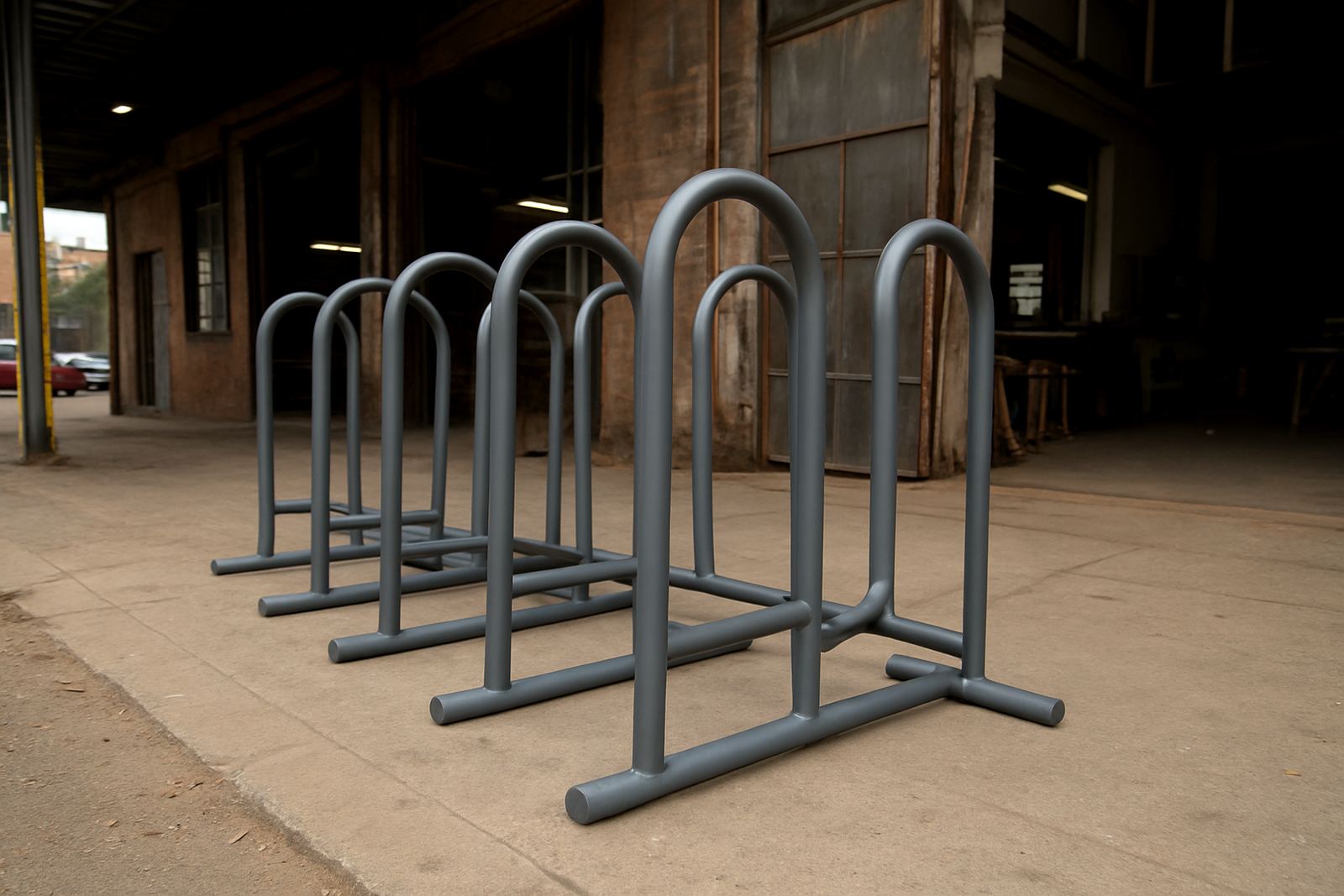
The brief called for a stand that would suit mixed-use public space and survive repeated handling without rattling loose. We advised on a simple steel frame layout with a low footprint, rounded contact points for bike frames, and enough spacing between parking points to avoid handlebar clashes.
Because the event ran outdoors, we allowed for fast change weather, dusty ground, and the kind of hard midday sun that can make cheap plastics brittle. The finish also had to be easy to wipe down at the end of the day, which matters when you are setting up early and packing up after dark.
We kept the design straightforward so that a local fabrication team could cut, weld, and finish the units without special tooling. That helped keep costs under control and made the build realistic for a tight production window.
- Frame material: mild steel tubing
- Finish: powder-coated or equivalent durable coating
- Parking style: alternating wheel slots and frame rests
- Use distance: suited to short-stay public parking
Workshop Support And Supply Details
Our role was to support the community group with a clear fabrication path, from sizing through to final placement. We supplied measured guidance for the stand width, slot spacing, leg stability, and anchor points so the build team could work from one agreed spec instead of guessing on site.
The stands were planned at about 1.8 metres long per unit, with a height of around 850 mm and a footprint narrow enough to fit along a boundary wall or open walkway. Each unit was designed to hold multiple bicycles in a line, while still leaving enough room for people to lock and open up frames without bumping into each other.
We also helped with practical event details such as safety signage placement, simple user instructions, and a clear setup plan for volunteers. The group wanted something that would not cause confusion during a busy activation, so we kept the format direct and visible.
- Approximate unit length: 1.8 metres
- Approximate stand height: 850 mm
- Floor requirement: level paving or compacted surface
- Signage: entry point, bike loading point, and no-climb notice
Timeline From First Brief To Event Day
The project ran over three weeks from first call to final handover. Week one covered the brief, site measurements, and the choice of a practical stand format. Week two was used for fabrication and finish checks, while week three focused on delivery support, placement guidance, and a final maintenance check before the event opened.
That schedule gave enough time to catch the small issues that often slow down community builds, like missing fasteners, uneven welds, or a finish that needs another coat. It also allowed the team to test the stands before load in, which is always worth doing when the event site is busy and there is no spare time for repairs.
The group appreciated having one clear point of contact during the process. It reduced back and forth and helped keep every step moving in the right order, even with volunteers coming and going.
- Week 1: brief, measurements, layout plan
- Week 2: fabrication and finish work
- Week 3: delivery support, placement and final checks
- Total turnaround: 3 weeks
How The Stands Performed On Site
On the day, the stands did what they were meant to do. Bikes were parked neatly, the queue moved faster, and the activation area stayed easier to manage because riders had a clear place to leave their bicycles. That mattered in a public setting where foot traffic can build quickly and volunteers have enough to manage already.
The group reported that the stands stayed stable across repeated use, even with different bike sizes coming through the line. The layout also made it simpler to keep the site looking organised, which helped with crowd flow and gave the event a more professional feel without turning it into something overcomplicated.
For a project like this, success is often measured in small practical wins. Less clutter, fewer complaints, easier supervision, and faster pack down. By those measures the bike stands did the job.
- Outcome: organised bicycle parking during the activation
- Result: smoother crowd movement
- Result: safer handling of bikes and fewer contact points in the walkway
- Result: faster pack-down at the end of the event
What We Would Repeat On The Next One
If we were doing a similar Pretoria project again, we would keep the same simple build logic and add one or two extras depending on the site. For a larger event, that could mean more spacing between units, clearer directional signage, or a heavier base if the location is exposed to wind.
We would also ask for the site surface details earlier in the process, because paving joints, slope, and access points can change how the stand sits once it is on the ground. That kind of detail saves time and avoids last minute shimming or repositioning.
For community teams, the best result usually comes from keeping the design practical, the materials easy to source, and the instructions short. It keeps the build affordable and makes the stands useful again for the next event or outreach day.
- Keep the layout simple and repeatable
- Confirm ground level and access in advance
- Use finishes that clean easily after outdoor use
- Plan for storage between events
Key facts
| Project type | Community bike stand fabrication for a public activation event |
|---|---|
| Town | Pretoria |
| Timeline | 3 weeks from brief to handover |
| Stand size | Approx. 1.8 metres long x 850 mm high |
| Material | Mild steel tubing with durable coating |
| Key use | Short-stay bicycle parking for mixed-age public traffic |