Why women change the rhythm of a maker space
Walk into a well-run maker space and you can feel when women are part of the leadership mix. The pace is calmer, the handover between users is clearer, and safety rules get taken seriously because someone is watching the details. That matters in places where band saws, soldering irons, drill presses and storage racks are shared by many hands every week.
In Johannesburg, we see this most clearly in spaces that serve students, small business owners and hobbyists at the same time. Women often become the people who notice what others miss: a loose cable across a walkway, a shelf that is too high, a first-aid box with items missing, or a cutter station that needs better lighting before evening sessions. These are not small things. They decide whether people feel welcome enough to return.
There is also a business case. When women lead, more beginners stay involved, more practical knowledge is shared, and group projects move faster because instructions are clearer. That is good for any makerspace, school lab or startup workshop trying to keep costs down while still producing useful work.
What confidence looks like on the workshop floor
Confidence in making is not about being loud. It shows up in the way someone checks a measurement twice, asks for the correct guard before using a tool, or stops a session to reset the sequence for a new member. In our training work, women often arrive with strong problem solving habits already in place, they just need the right support to use them openly.
Good entry points matter. Starter kits that include clear consumables, simple project notes and properly matched hand tools help remove the fear of making a costly mistake. So does knowing where to store shared items, how to label materials, and how to keep a project moving when load-shedding interrupts power tools or charging points.
- Start with one repeatable project, such as a storage caddy, plant stand or small repair job.
- Use a short safety checklist before every session, even for simple tasks.
- Keep tools in the same place every time so new users do not waste energy searching.
- Plan for backup lighting and manual tools when power is unreliable.
These habits build confidence quickly because they make the next step obvious. Once someone knows the rhythm of a space, the work feels possible.
Training that keeps women in the room, not on the edge of it
Training works best when it respects time, transport and real responsibilities. In Braamfontein, Sandton or Midrand, many participants are balancing work, family duties and travel costs. A good course should not assume people can stay for a long session or arrive with every material already sorted. The lesson plan should be tight, practical and built around what will be used again.
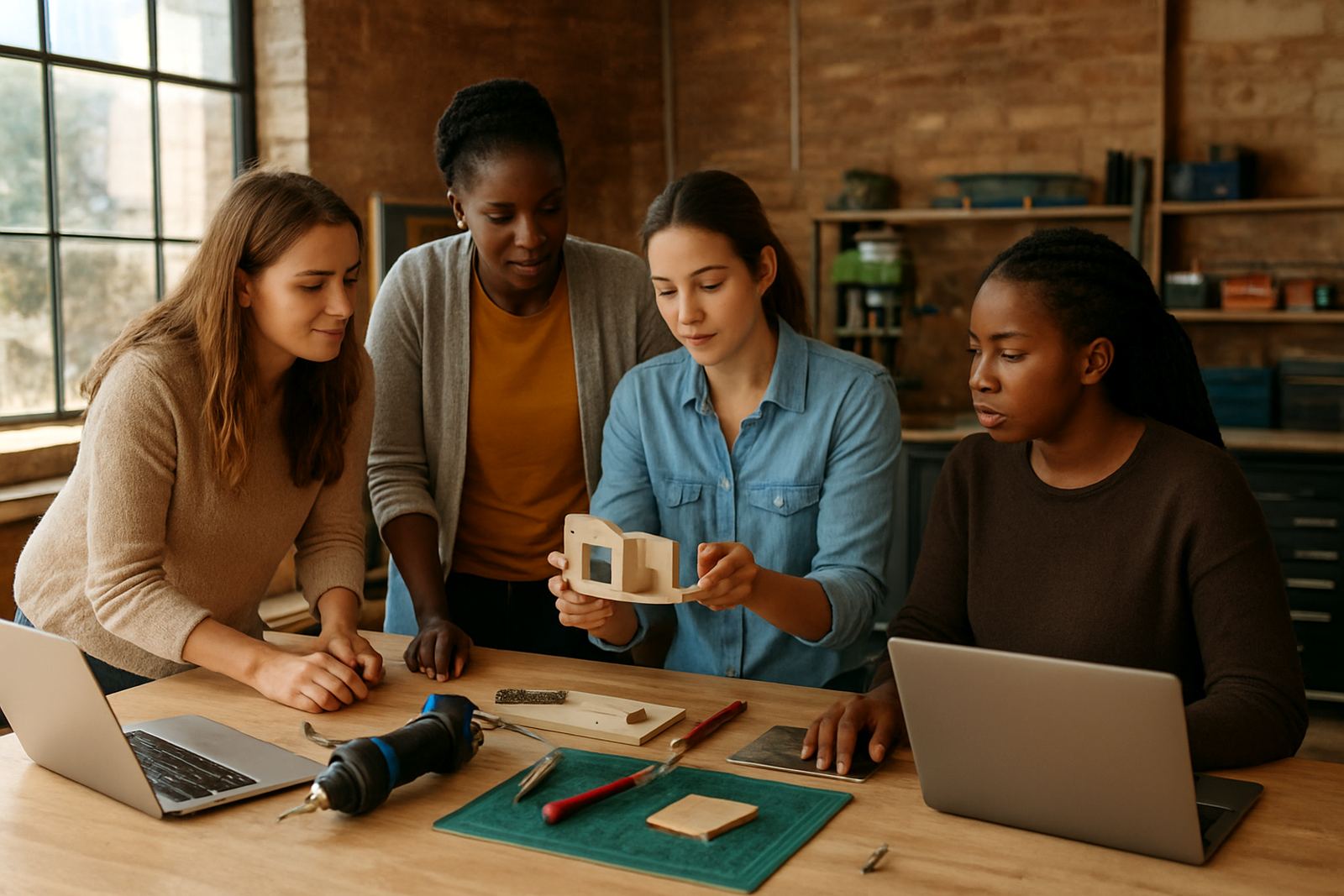
We have found that women respond well to training that covers tool handling, simple maintenance, storage systems and member onboarding in plain language. That kind of structure helps them move from observer to operator, and later to facilitator. It also helps organisations avoid the common mistake of training people on equipment but not on the system around it.
- Use short modules with clear outcomes, not long talks that drift off topic.
- Include safety signage setup, emergency exits and machine zones in every induction.
- Show how to report faults and organise maintenance checks before they become a shutdown.
- Build space for questions, because many good makers learn by asking and then trying again.
When training is done well, women do not just attend. They start leading sessions, supporting new members and improving the flow of the whole workshop.
A Pretoria East example: a school lab refreshed for mixed teams
A recent school lab refresh in Pretoria East showed how much difference a careful layout can make. The lab had capable learners, but the storage was cramped, the safety signs were unclear, and the maker stations were arranged in a way that forced people to cross paths too often. That is the kind of setup that slows everyone down, but it affects women and girls first because they are often the ones asked to organise, tidy or help others before they get proper access themselves.
By separating tool zones, improving storage solutions and setting up event maker stations with clear walking space, the room became easier to use. Consumables were grouped by task, the teaching table sat closer to the main bench area, and facilitator support could happen without blocking the full class. The result was simple: more participation, fewer delays and better use of the available equipment.
For schools, community labs and startup spaces, this is a useful lesson. Inclusion is not only about attendance. It is about whether the room lets people work without feeling like they are in the way. Small changes in layout can make a big difference to confidence and output.
What makerspaces should get right for women founders and teams
Women starting product businesses often need more than access to tools. They need a place that helps them plan costs, store materials safely and avoid wasted trips. In Durban and Gqeberha, coastal humidity can affect timber, paper, fasteners and packaged stock, so dry storage and regular checks are part of the service, not an optional extra. In Soweto or Pretoria East, space may be tighter, which makes layout even more important.
A makerspace that wants to serve women properly should think about the full journey from first enquiry to regular use. That means onboarding that is friendly but structured, a clear sign-in process, visible safety rules and support for teams who want to test a new idea before buying large quantities of material. If the space is used by schools, startups and part-time makers together, the system must stay simple enough for everyone to follow.
- Keep signage at eye level and use plain wording for machine zones and exits.
- Separate noisy, dusty and clean work areas where possible.
- Provide secure storage for work in progress and personal items.
- Review lighting, ventilation and cable runs before opening new stations.
That approach helps women work with less friction and more control. It also helps the space run better for every member, which is what good operations should do.
How SA Makers supports women-led making across South Africa
From Braamfontein to Cape Town, we work with partner makerspaces and training venues that need practical support, not theory. That includes space planning, tool zone layouts, startup space kits, facilitator support, maintenance checks and maker audits. For women leading a space or starting a project team, these services can remove the usual bottlenecks that eat time and confidence.
We also help with member onboarding and consumables planning so that a new group is not left guessing what to buy, where to store it or how much to keep on hand. That matters when budgets are tight and every Rand has to go further. If a space is set up properly from the start, women can spend more time creating and less time fixing avoidable problems.
Women in making are not a side story. They are central to how South African workshops, school labs and community spaces stay active, practical and useful. The more we support their leadership, the stronger the whole maker community becomes.